









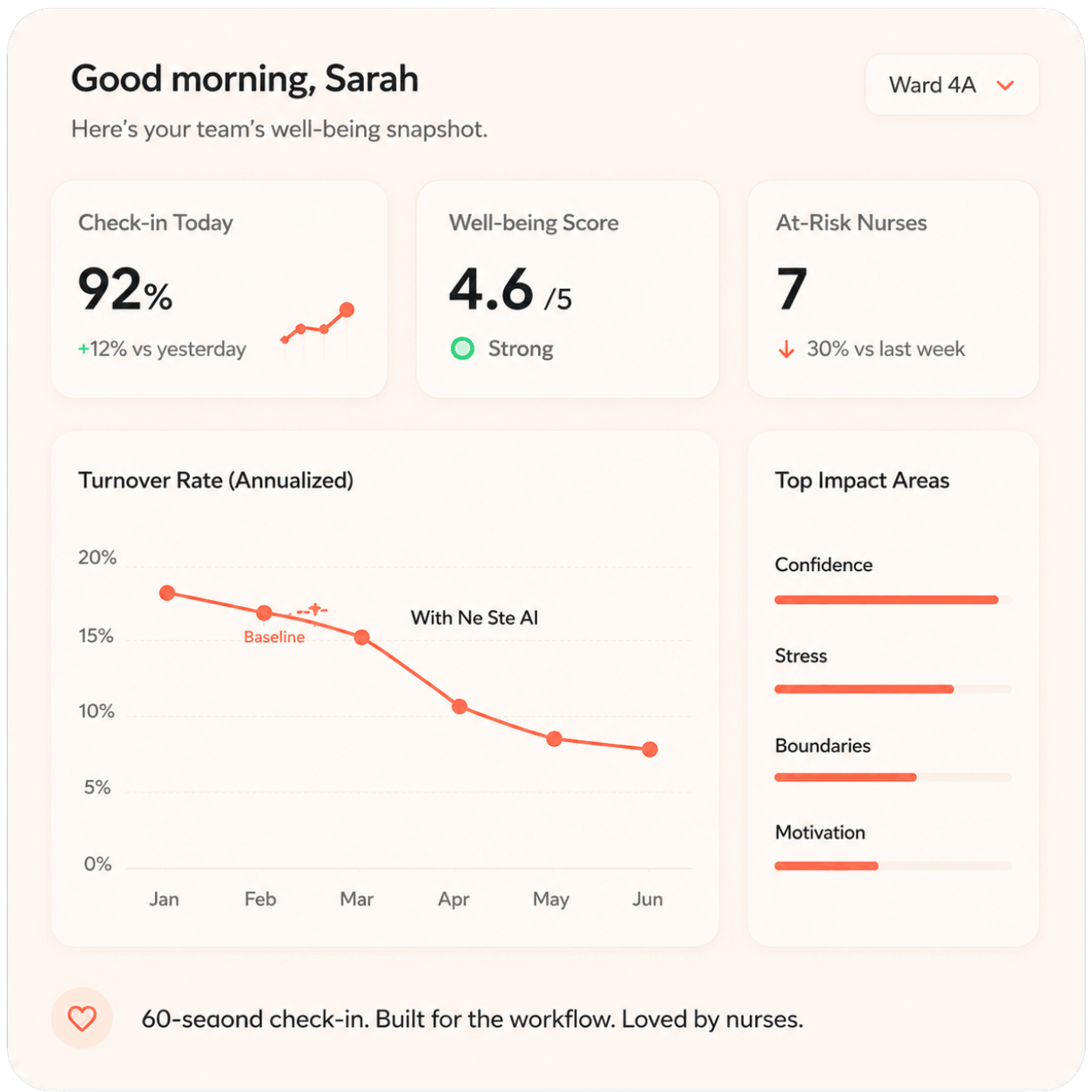
A structured pilot report at Day 10, 30, Day 60, and Day 90, covering participation rates and aggregated, unit-level workforce indicators (for example, average stress and burnout trends across the unit), plus a recommendation on next steps at the end of the 90-day evaluation.
No individual nurse’s identifiable data is included in any report your hospital receives.
The pilot establishes a baseline at Day 1, then tracks agreed participation, workforce, and outcome indicators through Day 10, 30, 60, and 90 — giving you a real before-and-a er comparison rather than a same-week verdict.
Ne Ste Al is a workforce-support tool, not a clinically validated medical treatment, and we’re upfront about that distinction with every hospital we work with.
What we can point to is the pilot itself: it’s built specifically to generate outcome data for your hospital, which we review together at Day 10, 30, 60, and 90, rather than asking you to take a claim on faith.
We also recognize that healthy skepticism is the right starting point. Rather than lead with a claim, we invite hospital leadership to experience a Frequency Therapy session personally, on a need of their own choosing — most people notice a clear, immediate shift in how they feel by the end of it.
It’s the fastest way to evaluate the approach yourself, before extending it to your team.
Usage varies by nurse and shift pattern.
The pilot tracks actual check-in frequency for your unit, so by Day 30 you’ll have a real usage figure specific to your hospital rather than an industry estimate.
The main reason nurses skip traditional wellness programs is time — a 50-minute work-related yoga session exercise after a 12-hour shift isn’t realistic.
Ne Ste AI is built around the shift itself:
- scan a QR code
- answer a few questions
- done.
About 60 seconds, no scheduled appointment.
No. The pilot is designed to begin without complex EHR or IT integration. Nurses access the check-in through a unit QR code; leadership receives agreed unit-level reports via email.
The pilot establishes a baseline and tracks agreed participation, workforce and outcome indicators over time. Individual treatments are instantaneous, effects are visible within minutes.
The pilot is designed to begin with a selected unit rather than requiring a hospital-wide rollout.
The pilot must be scheduled in advance as there are many hospitals in the waiting list.
Your hospital’s existing support and escalation pathway defines the appropriate response.
Ne Ste AI is not a crisis-monitoring or emergency-care system.
No extensive training is needed for nurses. The pilot team provides a short orientation for the hospital contact and unit leadership before activation.
The 10-day pilot program is FREE.
Hospital-wide licensing fee is presented after the pilot program.
The recommended structure is a 10-day activation followed by a 90-day evaluation.
During activation, nurses begin using the experience and the hospital confirms workflow fit and participation. During the evaluation period, Ne Ste Al tracks agreed indicators and provides an interim and final report.
Leadership receives agreed aggregated reporting on participation and workforce indicators. Individual nurse can be displayed to managers.
No. Ne Ste AI is a complementary workforce-support layer.
It does not diagnose, treat, cure, or prevent a medical or psychiatric condition, and it is not a replacement for your hospital’s existing clinical care, EAP, or emergency pathways.
Ne Ste AI is designed to support entire nursing teams at scale.
The number of participating nurses, units, and monthly check-ins is agreed during the pilot briefing, starting with your chosen pilot unit. Normally the number is between 40-60 nurses.
Ne ste al’s Frequency Therapy is completely safe and non-invasive with no harmful side effects. Some clients experience temporary emotional releases or mild fatigue as their body processes the healing—all normal signs of transformation.
Standard sessions are 15 minutes. This is preceded by answering questions which may take about 60 seconds.
The options are video call or completely remote.
If your staff are busy, remote is faster and more convenient while creating same results Before signing on a hospital unit, we give honest and clear upfront information on what our proprietary and unique method is and what it does.
No. It targets confidence, calm, motivation, and boundaries — before burnout becomes clinical.If it’s already critical, we work on that.
Many clients report feeling different during or immediately after their first 15-minute session. For lasting change that holds over years, we recommend additional sessions over time. Individual experiences vary. The whole nursing staff in 60-90 days, targeting the same shift PSMMC achieved in 4 years. Individual remote sessions are 15 minutes. Video calls are available in special cases where deeper attention is required.
