A More Stable Nursing Workforce Starts Before The Resignation Letter.

A More Stable Nursing Workforce Starts Before The Resignation Letter.

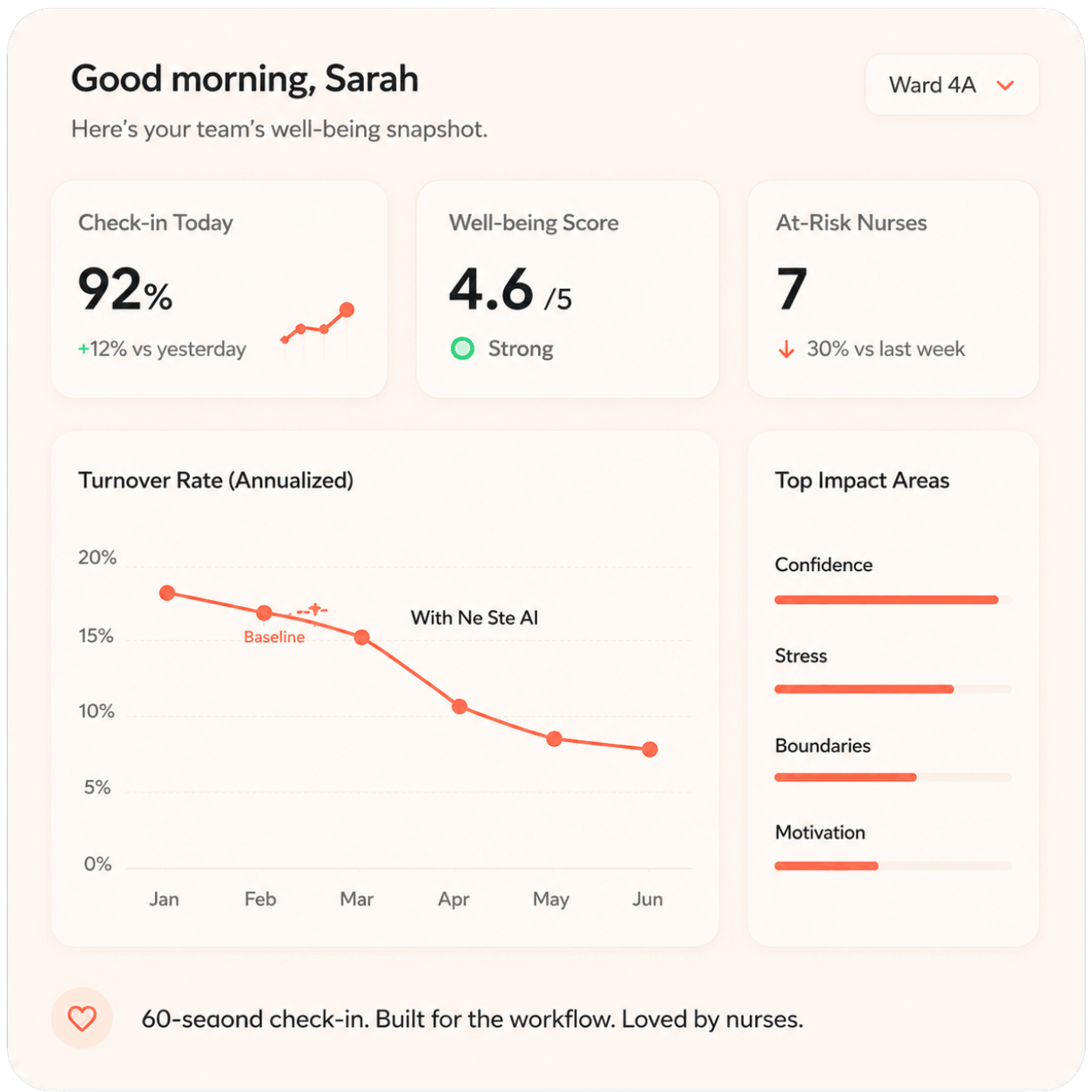
Ne Ste AI gives hospitals a practical way to support nurses through stress, burnout, and de-motivation — while giving nursing leadership earlier visibility into the workforce signals that often precede disengagement and turnover

dashboard-card-nurse-healthcare-solution nesteal

A More Stable Nursing Workforce Starts Before The Resignation Letter.

Ne Ste Al gives hospitals a practical way to support nurses through stress, burnout, and demotivation—while giving nursing leadership earlier visibility into the workforce signals that may precede disengagement and turnover.

dashboard-card-nurse-healthcare-solution nesteal

What Happens After a Nurse Checks In?

What Happens After a Nurse Checks In?

Nurses complete a 60-second check in. Frequency Therapy provides a personalized response.
Leadership sees aggregated unit trends. Hospitals can act earlier.

01

Start with a scan.

Scan QR Code

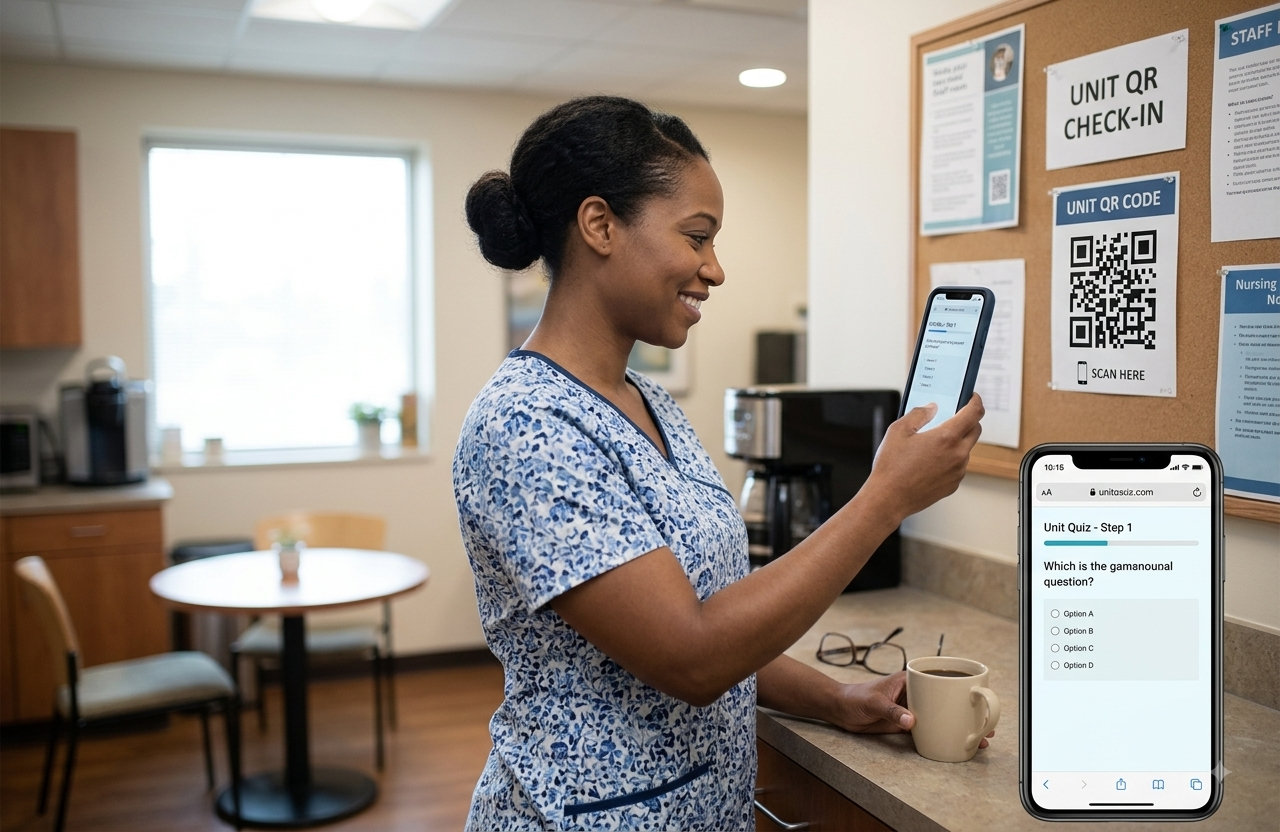
A nurse scans the unit QR code and opens the support check-in.

  • No login.

  • No training.

  • No new software.

The check-in is designed for the nurse—not for monitoring by management.

The scan opens one simple 60-second quiz..

step 2 - Check in without leaving the floor.

02

Check in.

Check in.

In approximately 60 seconds, the nurse identifies their core challenges and what they need support with.

  • Stress level
  • Burnout score

  • De-motivation analysis

  • Confidence.

  • Boundaries.

  • Motivation.

  • Calm.

One question at a time. No long form. No scheduled appointment.

The check-in creates a starting point.

03

Shift the state.

Shift the state.

Frequency Therapy provides a personalised response based on the nurse’s check-in—designed to help them pause, recognise their current state, and reconnect with a more useful state before returning to the shift.

Before: Strain levels

  • Stress: 10

  • Burnout: 8

  • De-motivation: 7

Before: Support levels

  • Self confidence: 4

  • Calm: 2

  • Work motivation: 2

  • Boundaries: 1

After: Strain levels

  • Stress: 2

  • Burnout: 3

  • De-motivation: 3

After: Support levels

  • Self confidence: 8

  • Calm: 8

  • Work motivation: 7

  • Boundaries: 5

Individual experiences vary. This is not a clinical diagnosis or treatment.

step 3- Support that starts with the moment 2
step 4 - nursing dashboard for administrators

04

See the pattern.

See the pattern.

Leadership sees aggregated unit-level trends—not individual nurse responses.

  • Participation: 78% (example)

  • Burnout signal: Trending down/up
  • Confidence trend: Improving or Not

  • Intention to stay: Stable / improving

The goal is not to monitor nurses. It is to help leaders see where support may be needed earlier.

What It Targets

Four signals burnout quietly erodes.

We remove stress, burnout and de-motivation, while adding self-confidence, calm, motivation for
work and boundaries to help nurses not only function but thrive at their work.

nurse if self confident

Self Confidence

The belief that you can handle what the shift demands.

nurse is calm, confident and harmonious

Calm

The ability to regain steadiness during pressure and interruption.

nurse motivation for work

Motivation for work

The sense of energy and connection that supports engagement with the work.

nurse boundaries work

Boundaries

The ability to recognise limits and protect them without unnecessary guilt

Frequently Asked Questions

Questions Hospital Leaders Ask (FAQs)

Yes, participation is voluntary for every nurse. Nurses are told clearly what’s collected, how it’s
used, and who has access to it before they participate. For identification purposes, the check-in
captures a nurse’s name, photo, and self-assessed ratings of stress, burnout, and motivation,
along with the changes she/he wants to work toward.

None beyond a short orientation for the hospital contact and unit leadership. Nurses just scan
and check in.

Individual sessions are designed to produce a noticeable shift during the session. For workforce-level
change, we recommend evaluating across the full 90-day measurement window, not a single
check-in — see the pilot page for the Day 10/30/60/90 framework.

Check-in responses (name, photo, self-assessed stress/burnout/motivation ratings, and
requested changes), plus participation data and the workforce indicators agreed with your
hospital. Only Ne Ste Al practitioners have access to a nurse’s full, identifiable data — needed to
deliver her session. Hospital leadership never sees identifiable individual data, only
aggregated, unit-level reporting. Retention period and reporting rules are confirmed before
activation.

No. The initial pilot begins without complex IT integration. Nurses access the check-in through
a unit QR code; leadership receives agreed unit-level reports via email.

Yes. A nurse’s identifiable responses are seen only by the Ne Ste Al practitioner delivering her
session — never by hospital managers, HR, or leadership. Leadership sees aggregated, unit
level trends only.

No. It targets confidence, calm, motivation, and boundaries before burnout becomes clinical.
It’s not a diagnosis, a treatment, or a replacement for your hospital’s existing clinical or EAP
pathways — it works alongside them.

Your hospital’s existing support and escalation pathway defines the response. Ne Ste AI is not a
crisis-monitoring or emergency-care system, and staff are trained to route anything beyond its
scope to your existing protocols immediately.

Happiness cannot be pursued; it must ensue.

Ready to see this on your units?

See exactly how a 10-day pilot works, what it measures, and the kind of retention improvement you can realistically target.