
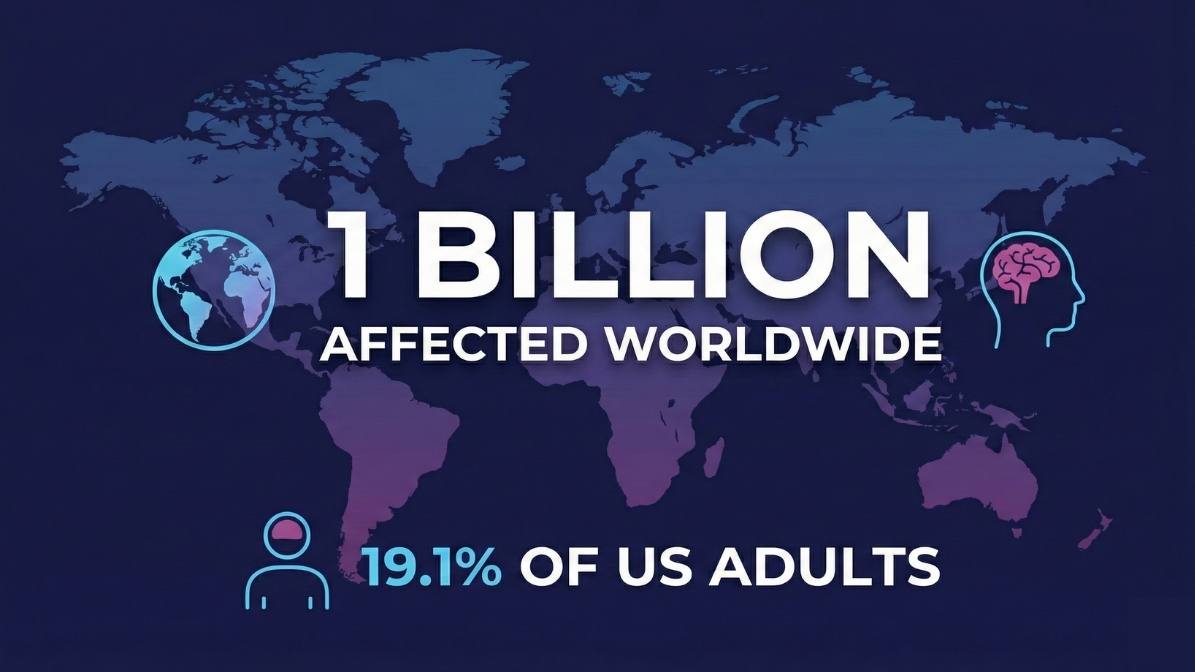
Anxiety disorders are among the most common mental health conditions worldwide, affecting hundreds of millions of people across age groups, cultures, and income levels. In the United States, about 19.1% of adults—roughly 42–43 million people—experience an anxiety disorder in a given year, underscoring how widespread and impactful these conditions have become.
Understanding anxiety statistics helps explain who is most affected, how anxiety changes over time, and which treatments work best, especially as we move through the lasting effects of the COVID‑19 pandemic and rapid digital change.
Global Prevalence of Anxiety Disorders in 2026
How Many People Live with Anxiety Disorders Worldwide?
WHO and global burden‑of‑disease studies estimate that around 4–4.5% of the world’s population is currently living with an anxiety disorder.
That translates to roughly 300–360 million people globally, making anxiety disorders one of the most common mental health conditions worldwide.
Authoritative global sources you can review:
-
WHO: Anxiety disorders fact sheet – https://www.who.int/news-room/fact-sheets/detail/anxiety-disorders
-
WHO: Mental disorders overview – https://www.who.int/news-room/fact-sheets/detail/mental-disorders
-
Global disease burden analyses (open access) – https://pmc.ncbi.nlm.nih.gov/articles/PMC11395616/
While older figures often cited “approximately 301 million” people with anxiety, more recent WHO updates suggest this number has risen as new data from the early 2020s are incorporated.
Anxiety Disorder Rates by Region
Anxiety prevalence is not evenly distributed across the globe.
-
High‑income countries tend to report higher diagnosed rates of anxiety, reflecting better access to mental‑health services, greater awareness, and more routine screening.
-
Low‑ and middle‑income countries often show lower recorded prevalence but may carry a large share of total cases because of their larger populations and substantial treatment gaps.
Burden‑of‑disease studies use indicators like the Socio‑demographic Index (SDI) to show that while high‑SDI nations report more diagnosed anxiety, middle‑ and low‑SDI regions account for a large proportion of global disability‑adjusted life years (DALYs) due to anxiety.
Projections suggest that without stronger prevention and treatment efforts, the absolute number of people living with anxiety disorders is likely to continue rising over coming decades.
Who Is Most Affected Globally?
Gender Differences
Across virtually all regions, women are more likely than men to experience anxiety disorders.
-
WHO notes that anxiety disorders are significantly more prevalent in females than males, a pattern seen in both community surveys and clinical samples.
-
This gender gap is especially pronounced during adolescence and early adulthood and remains an active area of research.
Biological factors (such as hormone fluctuations), psychological differences, social roles, and exposure to gender‑based violence and discrimination are all being studied as contributors.
Age Patterns: Why Youth Are a Focus
Age plays a major role in anxiety risk.
-
Many anxiety disorders first emerge between ages 10 and 24, making late childhood and adolescence critical periods.
-
Global analyses show that anxiety contributes substantially to the burden of disease among adolescents and young adults, second only to some other mental health and substance‑use conditions in this age group.
Young women face the highest combined risk, often experiencing overlapping stressors linked to social pressures, digital media exposure, education, and work transitions.
The Global Treatment Gap
Despite the scale of the problem, access to care remains limited.
-
WHO estimates that only about one in four people with anxiety disorders receive any form of treatment.
-
Treatment gaps are especially severe in low‑ and middle‑income countries, where mental‑health budgets are small and specialists scarce.
WHO has called for urgent scale‑up of mental‑health services, noting that over 1 billion people worldwide live with mental health conditions, including anxiety.
Further reading:
-
WHO mental health scale‑up call – https://www.who.int/news/item/02-09-2025-over-a-billion-people-living-with-mental-health-conditions-services-require-urgent-scal…
Trends in Anxiety Over Time
Long‑Term Trends (1990–2021)
Global burden‑of‑disease data show that anxiety‑related disability has risen steadily from 1990 through the early 2020s.
-
While point prevalence percentages may appear relatively stable, population growth and ageing mean that the absolute number of people with anxiety disorders has increased.
-
Anxiety‑related years lived with disability (YLDs) have grown across most world regions, indicating that anxiety remains a substantial and persistent contributor to non‑fatal health loss.
The COVID‑19 Spike
The COVID‑19 pandemic produced a marked, well‑documented spike in anxiety.
-
WHO estimates a 26% global increase in anxiety disorders in 2020 compared with pre‑pandemic baselines.
-
Lockdowns, social isolation, health fears, grief, economic uncertainty, and disruption of education all contributed.
Subsequent analyses suggest that anxiety levels have remained higher than 2019 levels, especially for adolescents and young adults. This has pushed mental‑health systems and researchers to prioritize remote care, telehealth, and scalable digital interventions.
Anxiety Statistics in the United States
Anxiety disorders are the most prevalent category of mental illness in the United States.
National Prevalence
NIMH provides the most widely cited U.S. estimates:
-
19.1% of U.S. adults experienced any anxiety disorder in the past year.
-
31.1% will experience an anxiety disorder at some point during their lives.
Translated into absolute numbers using current population figures, this represents approximately 42–43 million U.S. adults with an anxiety disorder in a typical year.
Key sources:
-
NIMH – Any Anxiety Disorder: https://www.nimh.nih.gov/health/statistics/any-anxiety-disorder
-
ADAA – Facts & Statistics: https://adaa.org/understanding-anxiety/facts-statistics
Surveys of self‑reported symptoms (which capture people who may not meet full diagnostic criteria) suggest even higher levels of anxiety‑related distress, with multiple polls showing rising percentages of adults who say they feel more anxious than in previous years.
Age and Gender Breakdown
Younger adults face the highest anxiety burden in the U.S.
-
Adults aged 18–44 have substantially higher past‑year rates of any anxiety disorder compared with adults 60 and older.
-
Among adolescents 13–18, approximately 31.9% have experienced an anxiety disorder, with higher rates in girls.
Gender differences are consistent:
-
23.4% of adult women vs. 14.3% of adult men had any anxiety disorder in the past year.
-
Girls and young women report particularly high rates of anxiety symptoms and related concerns, including worry, panic, and social anxiety.
Ethnic, Racial, and Socioeconomic Variations
Mental‑health disparities shape who is diagnosed and treated.
-
Communities facing structural barriers—such as limited local providers, lower insurance coverage, discrimination, and language barriers—often report higher symptom burden but lower rates of diagnosis and treatment.
-
Economic stressors, including debt, housing instability, and job insecurity, are strongly associated with higher anxiety levels.
Reports from Mental Health America (MHA) and the Kaiser Family Foundation (KFF) highlight how education, income, and insurance coverage contribute to differences in anxiety risk and access to care.
-
MHA – State of Mental Health in America: https://mhanational.org/issues/state-mental-health-america
-
KFF – Mental Health Collections: https://www.kff.org/mental-health/
Common Types of Anxiety Disorders
“Anxiety disorder” is a broad term that includes several specific diagnoses with distinct symptoms and prevalence patterns.
Generalized Anxiety Disorder (GAD)
Generalized anxiety disorder involves chronic, excessive worry about multiple aspects of life (health, finances, work, relationships), often accompanied by restlessness, fatigue, and sleep disturbance.
-
NIMH estimates that about 2.7–3.1% of U.S. adults have GAD in a given year.
-
Lifetime prevalence is around 5.7%.
GAD can develop at any age, but onset commonly occurs in childhood or adolescence, and many people report symptoms persisting for years without treatment.
Further details:
-
NIMH – GAD Statistics: https://www.nimh.nih.gov/health/statistics/generalized-anxiety-disorder
Panic Disorder
Panic disorder is characterized by recurrent, unexpected panic attacks and persistent fear of having additional attacks or their consequences.
-
Approximately 2–3% of U.S. adults (around 6 million people) are estimated to have panic disorder.
-
Women are more likely than men to experience panic disorder, and many people begin avoiding situations where they fear panic might occur.
Social Anxiety Disorder
Social anxiety disorder (social phobia) involves intense fear of social or performance situations where the person may be scrutinized or judged.
-
Around 7% of U.S. adults—roughly 15 million people—are affected.
-
Symptoms often begin in childhood or early adolescence and can limit schooling, career advancement, and relationships if untreated.
The Anxiety and Depression Association of America provides accessible summaries of these and other anxiety‑related conditions:
Impact of Anxiety on Daily Life
Work and Academic Performance
Anxiety disorders can significantly disrupt work, school, and home functioning.
-
In population‑based surveys, about 22.8% of adults with anxiety disorders report serious impairment in daily activities, and roughly 33–35% report moderate impairment.
-
Anxiety is associated with reduced productivity, more sick days, and increased risk of job loss or underemployment.
For students, anxiety can manifest as difficulty concentrating, fear of presentations, test anxiety, and school avoidance, all of which can affect long‑term educational outcomes. Adolescents with untreated anxiety are more likely to miss school and may miss out on important social experiences that support development.
Physical Health Consequences
Mental and physical health are closely linked.
-
Common physical symptoms of anxiety include headaches, muscle tension, gastrointestinal distress, chest discomfort, and sleep problems.
-
Chronic anxiety and stress are associated with elevated risk of cardiovascular disease and may weaken immune function over time.
WHO and major medical reviews emphasize that high‑quality care for anxiety should consider both mental and physical aspects of health, including lifestyle factors and comorbid conditions.
Diagnosis, Treatment, and Access to Care
Diagnosis Rates and Barriers
Even though anxiety disorders are highly treatable, many people never receive an accurate diagnosis or professional help.
-
WHO estimates that only about 25% of people with anxiety receive any treatment at all.
-
In the U.S., less than half of adults with an anxiety disorder report receiving mental‑health services in the previous year.
Key barriers include cost, lack of nearby providers (especially in rural areas), long waiting lists, limited insurance coverage, low mental‑health literacy, and stigma.
Evidence‑Based Treatments
The good news is that multiple evidence‑based treatments can significantly reduce anxiety symptoms and improve quality of life.
1. Cognitive Behavioral Therapy (CBT)
CBT helps people identify and change unhelpful thought patterns and behaviors associated with anxiety.
-
Meta‑analyses of non‑randomized outpatient CBT studies show large reductions in anxiety symptoms, often with effect sizes around d = 0.9 or higher.
-
A JAMA Psychiatry review found that CBT delivers moderate to large benefits across various anxiety‑related disorders, with effects that often persist for 6–12 months or more.
Key reviews:
-
CBT effectiveness meta‑analysis – https://www.sciencedirect.com/science/article/abs/pii/S0272735813000913
-
Long‑term CBT outcomes – https://jamanetwork.com/journals/jamapsychiatry/fullarticle/2756136
-
Recent CBT efficacy overview – https://pmc.ncbi.nlm.nih.gov/articles/PMC9834105/
2. Medication
Pharmacological treatments often include:
-
SSRIs and SNRIs as first‑line medications
-
Other antidepressants tailored to individual needs
-
Short‑term benzodiazepines in specific, carefully monitored situations
NIMH and WHO emphasize that medication should be individualized and, where possible, combined with psychotherapy for best results.
3. Lifestyle and Complementary Strategies
Evidence increasingly supports adjunctive strategies such as:
-
Regular physical activity
-
Sleep optimization
-
Mindfulness‑based stress reduction and relaxation techniques
For clinicians and health planners:
-
WHO mhGAP – guidance for mental‑health care in all settings: https://www.who.int/teams/mental-health-and-substance-use/mhgap
-
NIMH – Anxiety Disorders Treatments: https://www.nimh.nih.gov/health/topics/anxiety-disorders
Anxiety in Children and Adolescents
Prevalence Among Youth
Anxiety disorders are the most common mental health conditions in children and teens.
-
CDC estimates that about 11% of U.S. children ages 3–17 have a current anxiety diagnosis.
-
Among adolescents 13–18, about 31.9% experience an anxiety disorder, meaning nearly 1 in 3 teens is affected.
Gender differences are evident early, with more girls than boys receiving diagnoses of anxiety in childhood and adolescence.
Key youth references:
-
CDC – Children’s Mental Health: https://www.cdc.gov/childrensmentalhealth/index.html
-
NIMH – Child and Adolescent Mental Health: https://www.nimh.nih.gov/health/topics/child-and-adolescent-mental-health
School and Social Functioning
Untreated anxiety in youth can affect:
-
Academic performance and engagement
-
Participation in extracurricular activities
-
Peer relationships and social skills development
Adolescents with high anxiety are at higher risk for school avoidance, substance use, and later depressive disorders. However, age‑appropriate CBT and family‑based interventions show strong effectiveness, particularly when started early.
Comorbidity with Depression and Substance Use
Anxiety and Depression
Anxiety and depression often occur together rather than in isolation.
-
Large studies suggest that roughly half or more of individuals with an anxiety disorder will also meet criteria for a depressive disorder at some point.
-
Comorbid anxiety and depression are associated with more severe symptoms, worse functioning, and higher risk of relapse.
The DSM‑5 introduced an “anxious distress” specifier for major depressive disorder, reflecting the clinical importance of this overlap.
Further information:
-
ADAA – Depression facts and statistics: https://adaa.org/understanding-anxiety/depression/facts-statistics
Anxiety and Substance Use
Substance use disorders frequently co‑occur with anxiety disorders.
-
Some people use alcohol or drugs to cope with anxiety, which may provide short‑term relief but typically worsens symptoms and increases dependence risk over time.
-
Stimulants (such as cocaine or methamphetamine) and heavy alcohol use can directly induce or exacerbate anxiety symptoms.
Integrated care that addresses both anxiety and substance use simultaneously is often needed for sustained recovery.
Economic and Societal Costs
Financial Impact
Anxiety disorders carry substantial economic costs, both directly and indirectly.
-
A classic U.S. study estimated the annual cost of anxiety disorders at about $42.3 billion in the 1990s, including medical costs and productivity losses.
-
Newer work estimates that mental illness overall costs the U.S. around $282 billion annually—roughly 1.7% of GDP—similar to the impact of an average economic recession.
Key sources:
-
Economic burden of anxiety disorders – https://pubmed.ncbi.nlm.nih.gov/10453795/
-
Columbia/Yale/UW–Madison research brief – https://business.columbia.edu/research-brief/economic-impact-mental-illness
-
Fortune summary – https://fortune.com/well/article/us-economy-annual-mental-illness-cost/
Pressure on Healthcare Systems
Globally, over 1 billion people live with mental health conditions, including anxiety and depression, but mental‑health budgets remain relatively small in many countries.
This mismatch between need and investment results in overcrowded services, long waiting lists, and untreated illness, all of which amplify long‑term societal costs.
The same is true for healthcare workers and burnout.
Digital Media, Social Media, and Anxiety
Youth, Screens, and Worry
Digital media is increasingly recognized as both a risk and a resource for mental health.
-
City‑ and national‑level reports show that adolescents with heavy or problematic social media use are more likely to report anxiety and depressive symptoms.
-
Mechanisms include constant comparison, cyberbullying, fear of missing out, and exposure to distressing news.
Some youth also find supportive communities and valuable information online, demonstrating that the impact of digital media depends on pattern and context of use.
Key reports:
-
NYC DOH – Social Media and Mental Health (2024): https://www.nyc.gov/assets/doh/downloads/pdf/mh/social-media-mental-health-report-2024.pdf
-
Pew – Teens, Social Media and Mental Health (2025): https://www.pewresearch.org/internet/2025/04/22/teens-social-media-and-mental-health/
-
BBC reporting on problematic teenage social media use: https://www.bbc.com/news/articles/crl8d0x9lpdo
Future Directions in Anxiety Research
Researchers are focusing on earlier detection, more precise treatments, and closing treatment gaps worldwide.
Key directions include:
-
Digital health technology – Validated apps, online CBT platforms, and wearable devices that track sleep, heart rate, and stress to tailor support.
-
Prevention in youth – School‑based and community programs to identify and help at‑risk children and teens before full‑blown disorders develop.
-
Neurobiological research – Brain imaging and genetic studies to better understand the circuits and pathways involved in anxiety.
-
Equity and access – Culturally adapted interventions and policy changes aimed at improving access to care in underserved regions and marginalized communities.
WHO and partner organizations continue to call for substantial, sustained investment in mental‑health services, including anxiety prevention and treatment, as a core part of global health strategy.
Related Posts
Nurse Retention Statistics South Korea 2026
Nurse Shortage Statistics UAE 2026
Nurse Retention Statistics UAE 2026
Nursing Shortage Statistics 2026 (United States)
Nurse Shortage Statistics Hong Kong 2026
Nurse Shortage Statistics Germany 2026
Nurse Shortage Statistics Poland 2026
Nurse Shortage Statistics Ireland 2026
Burnout signs, symptoms and causes
Sources
For convenience and transparency, here is a consolidated list of key high‑authority references and datasets that informed the statistics and statements above:
-
WHO – Anxiety Disorders: https://www.who.int/news-room/fact-sheets/detail/anxiety-disorders
-
WHO – Mental Disorders: https://www.who.int/news-room/fact-sheets/detail/mental-disorders
-
WHO – Global Mental Health Scale‑Up: https://www.who.int/news/item/02-09-2025-over-a-billion-people-living-with-mental-health-conditions-services-require-urgent-scal…
-
NIMH – Any Anxiety Disorder (Adults & Adolescents): https://www.nimh.nih.gov/health/statistics/any-anxiety-disorder
-
NIMH – Generalized Anxiety Disorder: https://www.nimh.nih.gov/health/statistics/generalized-anxiety-disorder
-
NIMH – Anxiety Disorders Topic Page: https://www.nimh.nih.gov/health/topics/anxiety-disorders
-
CDC – Mental Health: https://www.cdc.gov/mental-health/index.html
-
CDC – Children’s Mental Health: https://www.cdc.gov/childrensmentalhealth/index.html
-
ADAA – Anxiety Facts & Statistics: https://adaa.org/understanding-anxiety/facts-statistics
-
ADAA – Understanding Anxiety: https://adaa.org/understanding-anxiety
-
ADAA – Depression Facts & Statistics: https://adaa.org/understanding-anxiety/depression/facts-statistics
-
Global burden and adolescent anxiety analyses (example open‑access GBD‑style studies): https://pmc.ncbi.nlm.nih.gov/articles/PMC11395616/ and https://pmc.ncbi.nlm.nih.gov/articles/PMC11651023/
-
CBT effectiveness meta‑analysis: https://www.sciencedirect.com/science/article/abs/pii/S0272735813000913
-
Long‑term CBT outcomes (JAMA Psychiatry): https://jamanetwork.com/journals/jamapsychiatry/fullarticle/2756136
-
Recent CBT efficacy review: https://pmc.ncbi.nlm.nih.gov/articles/PMC9834105/
-
Economic burden of anxiety disorders: https://pubmed.ncbi.nlm.nih.gov/10453795/
-
NBER/Columbia mental‑illness cost estimate: https://business.columbia.edu/research-brief/economic-impact-mental-illness
-
Fortune summary of $282B estimate: https://fortune.com/well/article/us-economy-annual-mental-illness-cost/
-
Mental Health America – State of Mental Health: https://mhanational.org/issues/state-mental-health-america
-
Kaiser Family Foundation – Mental Health: https://www.kff.org/mental-health/
-
NYC DOH – Social Media & Mental Health (2024): https://www.nyc.gov/assets/doh/downloads/pdf/mh/social-media-mental-health-report-2024.pdf
-
Pew – Teens, Social Media and Mental Health (2025): https://www.pewresearch.org/internet/2025/04/22/teens-social-media-and-mental-health/
-
BBC article on problematic teenage social media use: https://www.bbc.com/news/articles/crl8d0x9lpdo

