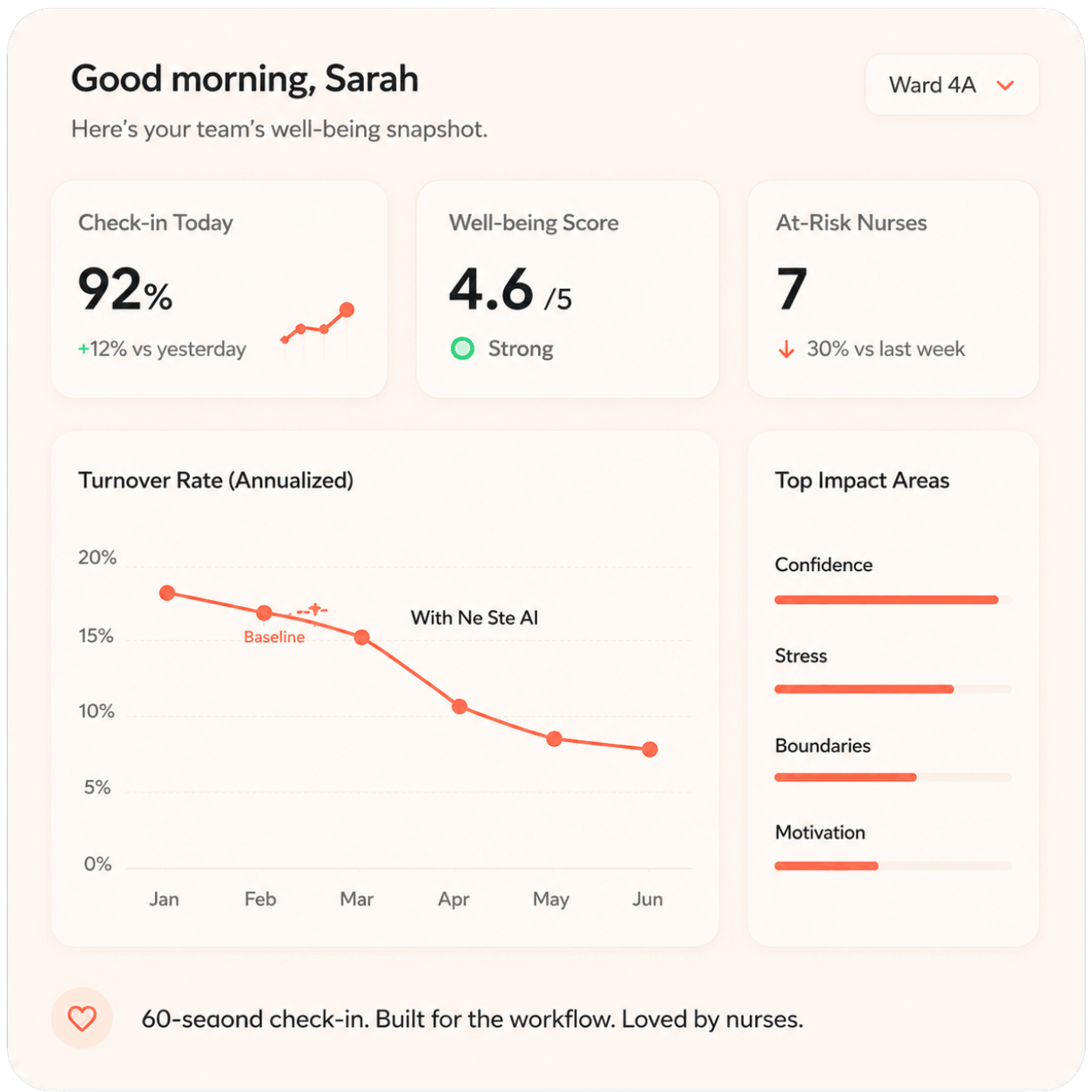
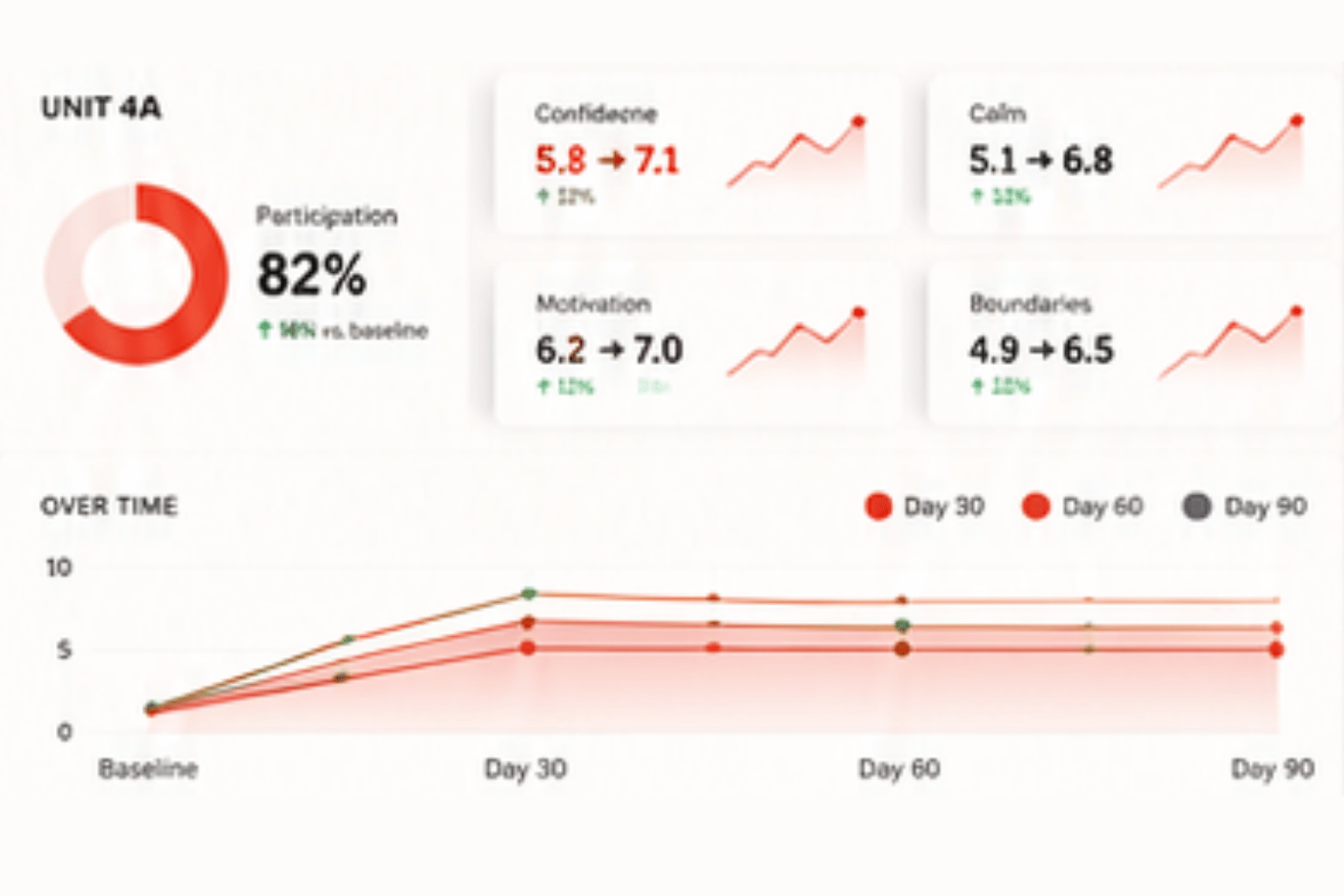
10-DAY NURSE RETENTION PILOT

Start With One Unit.
See What Changes Before You Scale.

Break Any Habit in 15 Minutes

Give your nurses access to a 60-second check-in and personalized support—while your hospital establishes a baseline and measures agreed workforce indicators.

Rating from 40+ companies.

60 SEC

Nurse check-ins

10 DAYS

Activation period

1 UNIT

Pilot scope

30 DAYS

Measurement window

Your Best Nurses Don’t Leave Overnight.

Right now, one of your best nurses might be thinking about leaving.

You cannot fix the lack of staff. You cannot fix the lack of money. You may have tried other programs before, and they stopped working after a few weeks.

But there is one thing you can still do. You can give your nurses 15 minutes that could help them stay, instead of leaving. Unlike wellness apps or talk-based programs that work on the surface, this addresses stress at the root — where burnout actually starts to build.

The Dream

Picture this:

  • Every nurse comes to work for their shift.
  • No more scrambling to find someone to cover a missing nurse.
  • Your best nurses stay, instead of quitting.
  • And you spend less money on extra pay and temporary staff just to get through the week.

That is what this program is for.

What You Get

  • One 15-minute session, made just for each nurse. Not a group class where nobody’s problem gets solved.

  • 10 days, with a clear start and end.

  • Free. No cost. No need to ask for money or approval.

  • Done online. No travel needed. Your nurses do it from their phone.

  • Nurses choose to join. No one is forced. This makes it easier for everyone to say yes.

  • We do the work. You just send us a list of names. That is all.

  • We ask each nurse how they feel, before and after. This gives you real numbers to show the hospital administration — not vague promises.

  • Many nurses report feeling noticeably calmer after just one session — not after weeks.

  • Reduced stress is commonly linked to fewer last-minute call-offs, which can mean fewer scheduling scrambles for you.

  • When nurses feel supported, more of them stay. This can mean spending less on extra pay and temporary staff over time.

  • Because it is free, you can see if it works before you decide anything else.

  • You can show your boss real results from your own nurses. Not just a story from us.

10 DAYS TO ACTIVATE.
MEASURE WHAT CHANGES.
THEN DECIDE WHETHER TO SCALE.

What people say about Ne Ste Al’s Frequency Therapy

The Ne Ste Al Frequency Therapy has been tested in 5 different categories successfully., including mental health, burnout, habits, phobias, and self limiting beliefs.

Meet Petri Maatta

Vishen Lakhiani is an award-winning entrepreneur, speaker, New York Times best-selling author, and Founder of Mindvalley: a global education movement with millions of students worldwide. Through Mindvalley, Vishen has spent over 15 years reimagining the human experience and exploring the science of helping humans reach their fullest potential.

Vishen is a certified Silva instructor and credits The Silva Method both as the foundation for his personal growth journey, and for many of his personal breakthroughs. These breakthroughs include writing a book that hit #1 on Amazon for all books globally, creating a $100M company with no VC funding, and developing mental training models used by the world's top athletes and entrepreneurs.

By publishing The Silva Ultramind System through Mindvalley, Vishen aims to re-introduce The Silva Method to a whole new generation of personal growth students, so more people can harness this remarkable framework to awaken their mind’s fullest abilities.

Vishen also holds a Bsc in Electrical Engineering and Computer Science and has been invited to speak at companies like Google, Facebook, and even the United Nations.

Author featured on

lifehack-manifest-great-life-logo

Apply For The PilotApply For The Pilot

Your Questions Answered

Your Questions Answered

The pilot starts with one selected nursing unit. The exact number of participating nurses is agreed during the pilot briefing based on the size and structure of the unit. Ne Ste AI is designed to support entire nursing teams at scale.

The pilot is designed around a 10-day activation period. Nurses begin using the check-in and support experience, then the hospital reviews participation and agreed before-and-after stress, burnout and de-motivation indicators.

For broader workforce measurement, we recommend continuing to track agreed indicators beyond the initial activation period.

No. The initial pilot is designed to begin without complex EHR integration. The goal is to get a selected unit up and running without creating a major IT project.

You provide one participating nursing unit, an internal point of contact, needed to evaluate the pilot. Ne Ste AI handles the pilot setup and nurse experience.

The pilot is designed to avoid hospital-wide rollout, manager referrals, scheduling, and additional tracking burdens.

Nurses complete a short check-in—approximately 60 seconds—at a natural point during their shift.

The check-in captures self rated stress, burnout and de-motivation factors. We ask them to define qualities they want to have to function better: reduction of stress, increased confidence, motivation at work, calm and boundaries.

Their responses then shape a personalized Frequency Therapy experience. It's designed to fit around normal clinical work.

Leadership sees aggregated, unit-level workforce signals, including nurse participation and changes over time.

The purpose is to help leaders understand patterns across the workforce, not to monitor individual nurses.

Yes. Individual nurse responses remain private. Leadership receives aggregated unit-level trends rather than individual nurse responses.

No. Ne Ste AI is designed as an additional workforce-support layer, targeting areas such as confidence, calm, motivation and boundaries before burnout becomes clinical. It is not a replacement for clinical care or the hospital's existing support and escalation pathways.

At the end of the 10-day activation period, the hospital reviews participation, baseline comparisons and the agreed workforce indicators. From there, you decide whether the evidence supports continuing, expanding to additional units, changing the approach, or stopping.

The point of the pilot isn't to force a rollout. It's to give you enough evidence to make the next decision.

No. The pilot is designed to establish a baseline, measure participation and agreed workforce indicators, and determine whether the evidence supports further investment.

46.2%

Fewer sick days

81%

Higher staff satisfaction

47.4%

Lower staff turnover

100%

More energy on the floor