Fact-checked against primary sources: Statistics Poland (GUS), Poland’s Ministry of Health Maps of Health Needs, the Jagiellonian University Medical College, and the All-Poland Trade Union of Nurses and Midwives (OZZPiP). Last verified August 2026.
Poland has 5.8 nurses per 1,000 people. The OECD average is over 11. That single ratio — Poland running at roughly half the developed-world benchmark — is why nursing unions, the Ministry of Health, and peer-reviewed researchers all describe the same crisis using nearly identical numbers, which is rare in this kind of workforce research. The country currently has a documented shortage of about 160,000 nurses, and every available demographic model says it’s going to get worse before it gets better.
This is Poland’s clearest workforce statistic pattern of any country in this series: the data isn’t scattered across competing models the way Saudi Arabia’s or the UAE’s is. Statistics Poland’s official headcount, the Ministry of Health’s own Maps of Health Needs, and independent union and academic research all converge on the same story — an aging nursing workforce that isn’t being replaced fast enough, concentrated in a system that still lacks a comprehensive long-term staffing plan.
Below are the 20 nurse shortage statistics for Poland that matter most in 2026.
Nurse Shortage Statistics Poland at a Glance
-
219,881 — practicing nurses in Poland in 2024, official count (Statistics Poland / GUS)
-
5.8 — nurses per 1,000 population in Poland, versus an OECD average exceeding 11
-
~160,000 — current estimated nationwide nurse shortage, per a 2025 OZZPiP union report based on official data
-
+100,000 — additional shortfall projected to develop over the next 15 years on top of the current gap
-
22% — share of Poland’s nursing workforce already eligible for retirement as of 2023
-
49.9 years — average age of a practicing nurse in Poland in 2023
-
64.5 years — the effective (actual) age at which Polish nurses leave the profession, well above the average female labor-force exit age of 60.7
-
−1,756.61 — the annual net deficit between new nursing entrants and nurses reaching retirement age, per the Ministry of Health’s 2025 Maps of Health Needs
-
300 — counties (out of Poland’s roughly 380) reporting an active nurse deficit or significant shortage as of the 2026 Occupational Barometer, with zero counties reporting a surplus
-
26% — the gap between Poland’s nurse-to-population ratio and the EU27 average (5.7 vs. 8.4 per 1,000), among the lowest in the European Union
Nurse Shortage Statistics Poland: Current Workforce Size
-
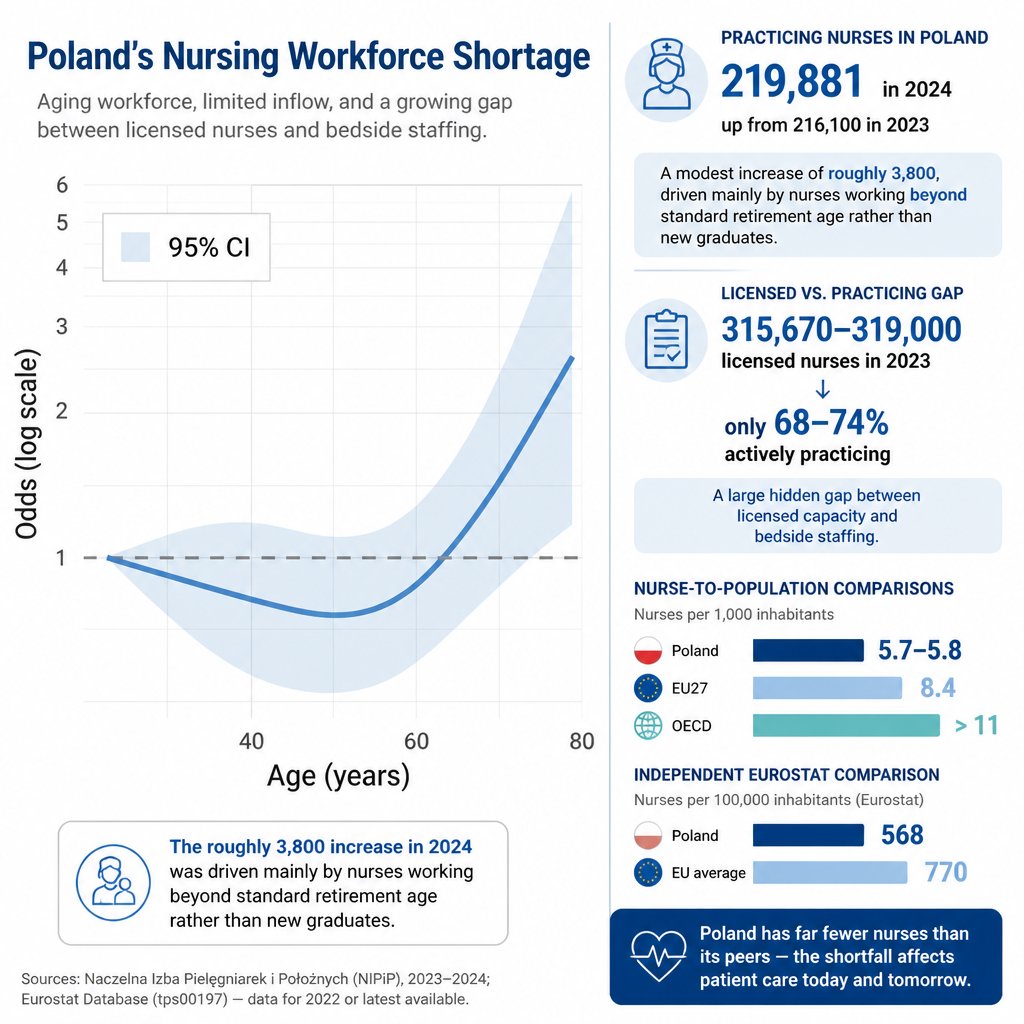
Statistics Poland’s official 2024 count puts practicing nurses at 219,881, up from 216,100 in 2023 — a small year-over-year gain of roughly 3,800, driven almost entirely by nurses working past standard retirement age rather than new graduates entering the workforce. [web:205][web:207]
-
A much larger pool holds a nursing license but isn’t practicing. The Central Register of Nurses and Midwives recorded roughly 315,670–319,000 licensed nurses as of 2023, meaning only about 68–74% of licensed nurses are actively working in the profession — a substantial “hidden” gap between credentialed capacity and real bedside staffing. [web:202][web:208]
-
Poland’s nurse-to-population ratio sits at 5.7–5.8 per 1,000 inhabitants, compared with the EU27 average of 8.4 and the OECD average exceeding 11 — placing Poland among the lowest-ranked EU member states on this specific benchmark. [web:202][web:207]
-
A separate Eurostat-based measure puts Polish nurse density at 568 per 100,000 population, against an EU average of 770 per 100,000 — a smaller absolute gap than the OECD comparison but confirming the same relative shortfall using an independent data source. [web:204]
Nurse Shortage Statistics Poland: The Size of the Gap
-
The current national nurse shortage is estimated at roughly 160,000, according to a 2025 report by the All-Poland Trade Union of Nurses and Midwives based on official government data — a figure the union frames not as an opinion but as a direct read of the gap between actual staffing and documented need.
-
That shortage is projected to worsen by a further 100,000 over the next fifteen years, driven primarily by retirements outpacing new entrants to the profession, not by declining interest in nursing as a career.
-
If Poland matched the nurse-to-population ratio of comparable health systems with similar nursing responsibilities, it would need more than 370,000 practicing nurses today — nearly 70% more than the current 219,881 headcount.
-
Extending that benchmark forward, demographic and demand modeling suggests Poland should have roughly 461,000 nurses working with patients by 2039 to keep pace with an aging population — but the union’s own trend-based projection instead points toward a decline to under 200,000 nurses within fifteen years without intervention.
Nurse Shortage Statistics Poland: An Aging, Retiring Workforce
-
22% of Poland’s nursing workforce had already reached retirement-eligible age by 2023, and the average nurse age that year was 49.9, nearly identical to the average age among physicians (50.8).
-
The effective (real-world) age at which nurses leave the profession is about 64.5 years — notably higher than the average female labor-force exit age of 60.7 in Poland, meaning nurses are already working well past typical retirement, not retiring early.
-
More than one-fifth of currently practicing nurses already hold pension rights, and almost the entire 2024 increase in practicing-nurse headcount (3.8 thousand more nurses than the year before) came specifically from nurses over age 60 — younger graduates are not driving the modest growth the numbers show.
-
The Ministry of Health’s own Maps of Health Needs 2025 calculates a net annual deficit of 1,756.61 nurses — the difference between new nurses entering the market and nurses reaching retirement age — confirming that outflow currently exceeds inflow even before accounting for early attrition among younger nurses.
-
Between 2019 and 2023, the working-age nursing population (excluding those past standard retirement) shrank from 181,000 to 172,000, even as the total headcount of practicing nurses grew slightly — direct evidence that the system is being “patched” by retirement-age staff rather than genuinely renewed.
Nurse Shortage Statistics Poland: Why More Graduates Haven’t Closed the Gap
-
Poland now produces roughly 6,000–8,000 nursing graduates per year, yet this hasn’t translated into a proportional increase in nurses actually working with patients — union leadership explicitly attributes this to new graduates leaving the profession within months of starting, not to insufficient enrollment.
-
New nursing students are frequently placed into hospital roles without adequate preparation or mentorship, and many resign within a few months to a year, moving either to private-sector roles, non-clinical work, or leaving nursing entirely — a retention failure occurring specifically at the front end of the career pipeline.
-
Poland lacks a well-developed “nursing assistant” or caregiver support role at the scale seen in benchmark countries, where such supporting positions exist in numbers roughly equal to the nurse workforce itself — in Poland, this remains a niche profession, meaning nurses absorb tasks that would otherwise be delegated elsewhere.
-
Growth in the number of educated nursing graduates has run at less than half the pace assumed by the government’s own 2019 nursing development strategy, according to the union’s 2026 update report — a direct, documented shortfall against the government’s own stated policy target.
Nurse Shortage Statistics Poland: Regional and Structural Variation
-
Nearly 300 Polish counties report an active nurse deficit or significant shortage under the 2026 Occupational Barometer, with zero counties reporting a surplus — confirming the shortage is now a nationwide condition, not a rural or regional anomaly. [web:207]
-
Inequality between regions is widening, not narrowing. Voivodeships that already had the fewest nurses per capita — such as Lubuskie, with 541 nurses per 100,000 population versus Mazowieckie’s 899 — continue growing more slowly than the national average, deepening rather than closing the regional gap.
-
Poland’s own 2025 EURES labor market assessment lists nursing professionals among occupations facing a labor shortage in 20 European countries simultaneously, including neighbors like Germany and Slovakia — meaning Poland is competing regionally for the same limited pool of nurses, not solving its shortage in isolation.
Why Nurse Shortage Statistics in Poland Are Unusually Consistent
Unlike several other countries in this series, Poland’s shortage figures don’t fracture into competing methodologies nearly as much — and it’s worth explaining why:
-
A single official data source anchors most figures. Statistics Poland (GUS) publishes an annual practicing-nurse headcount that unions, the Ministry of Health, and academic researchers all cite directly, rather than relying on private industry surveys or competing consultancy models.
-
The Ministry of Health’s Maps of Health Needs is a recurring, government-mandated planning document, not a one-off study, giving Poland a rare multi-year, standardized government projection that other countries in this series (aside from the U.S.’s HRSA model) largely lack.
-
International benchmarks (OECD, Eurostat) and domestic figures broadly agree, both showing Poland well below EU and OECD nurse-density averages — a rare case where cross-checking against an entirely independent international dataset confirms rather than contradicts the domestic figure.
Where genuine disagreement exists, it’s mostly about the future trajectory rather than the current state: whether increased nursing school admissions will meaningfully close the gap (most experts interviewed for the 2025 Jagiellonian University study were skeptical, citing quality-of-education tradeoffs), and how many licensed-but-inactive nurses could realistically be drawn back into practice.
What the Evidence Says Would Help
-
Fix early-career retention before expanding enrollment further. Multiple sources agree that increasing admission limits without addressing why new graduates leave within months is unlikely to close the gap — quality-of-education tradeoffs from rapid enrollment growth are a specific, repeated concern raised by healthcare stakeholders.
-
Build a nursing-assistant/caregiver support tier at scale, following the model of countries where such roles exist in numbers comparable to the nurse workforce itself, freeing licensed nurses from tasks that don’t require their specific credential.
-
Update staffing standards to reflect actual workload, not just bed counts. Experts specifically flag that current staffing formulas are based on patient or bed counts rather than the real time and complexity of modern nursing work, which understates true staffing need.
-
Develop a comprehensive, multi-year national nursing workforce strategy, following examples cited from Germany, Norway, and Switzerland, which run staffing security plans through 2040 — Poland’s stakeholders themselves identify the absence of such a plan as a central, solvable gap.
-
Address compensation growth relative to inflation specifically, since stakeholders note recent wage increases for medical staff have been partially offset by inflation, blunting their intended retention effect.
Burnout, workload, and mental health support for nurses are explicitly flagged as a critical retention lever in Poland’s own 2025 stakeholder research, not an afterthought.
Employer-led staffing reform, updated workload standards, and licensed clinical mental health support remain the primary tools for addressing this. Some facilities may also explore complementary, non-clinical wellbeing resources to supplement licensed care — remote sessions such as Ne Ste Al Frequency Therapy, for example, as one additional layer alongside employer-provided support, not instead of it. Ne Ste Al does not diagnose, treat, cure, or prevent any medical or psychiatric condition, and individual results vary; nurses experiencing burnout or clinical symptoms should consult a licensed healthcare provider first.
Frequently Asked Questions
How big is the nurse shortage in Poland?
Poland’s current documented nurse shortage is approximately 160,000, based on a 2025 union report using official government data, with a further 100,000-nurse shortfall projected to develop over the next fifteen years without intervention.
Why does Poland have so few nurses compared to other EU countries?
Poland’s nurse-to-population ratio of 5.7–5.8 per 1,000 is well below the EU27 average of 8.4 and the OECD average exceeding 11. Contributing structural factors include an aging workforce (22% already retirement-eligible), high early-career attrition among new graduates, and slower-than-planned growth in nurses actually working with patients despite rising enrollment.
Is the number of nurses in Poland increasing or decreasing?
Officially increasing, but the underlying trend is concerning. Statistics Poland recorded 219,881 practicing nurses in 2024, up from 216,100 in 2023 — but almost all of that growth came from nurses over age 60 continuing to work past standard retirement, not new graduates, and the working-age nursing population actually shrank between 2019 and 2023.
Why haven't more nursing school graduates fixed the shortage?
Poland now graduates 6,000–8,000 new nurses annually, but many resign within months of starting due to inadequate onboarding support, moving to non-clinical roles or leaving the profession entirely. Experts also warn that further increasing enrollment without fixing retention risks lowering education quality rather than solving the staffing gap.
Which parts of Poland are most affected by the nurse shortage?
Nearly all of them. Almost 300 of Poland’s counties report an active nurse deficit or significant shortage, with none reporting a surplus, according to the 2026 Occupational Barometer. Regional inequality is also widening, with already low-density voivodeships like Lubuskie growing more slowly than higher-density regions like Mazowieckie.
Related
Nurse Turnover in U.S. Hospitals
Nursing Shortage Statistics 2026 (United States)
Nurse Shortage Statistics Hong Kong 2026
Nurse Shortage Statistics UAE 2026
Sources
-
Human Resources in Selected Medical Professions Based on Administrative Sources in 2024 — Statistics Poland (GUS)
-
Addressing the Health Workforce Crisis in Poland from the Key Stakeholders’ Perspectives — BMC Health Services Research, Jagiellonian University Medical College, 2025
-
Map of Health Needs 2022–2026 — Official Journal of the Minister of Health, Poland
-
National Transformation Plan — Poland Ministry of Health
-
Nurses: System Increasingly Dependent on Seniors — Medexpress, citing the OZZPiP “Staffing Analysis of Nurses – An Update” report, 2026
-
Nurses Too Few, and There Will Be Even Fewer. A Crisis Is Looming — Medexpress, citing the All-Poland Trade Union of Nurses and Midwives (OZZPiP)
-
EURES Report on Labour Shortages and Surpluses 2025 — Nursing Professionals — European Labour Authority
-
Public Health and Pharmaceutical Industry in Poland — European Parliament Research Service