Fact-checked against primary sources: the Department of Health – Abu Dhabi (DOH), Dubai Health Authority (DHA), the Ministry of Health and Prevention (MOHAP), and peer-reviewed UAE nursing workforce studies. Last verified August 2026.
According to nurse retention statistics, retention rate is no longer a “nice to track” metric in Abu Dhabi’s healthcare sector — as of September 2026, it’s a named, mandatory Objective Well-being Indicator that every DOH-licensed hospital must measure, report, and act on, under a policy carrying formal disciplinary sanctions for non-compliance.
That single regulatory shift explains why UAE nurse retention statistics look so different depending on which study you read: one peer-reviewed 2025 study found 40.8% of UAE nurses report a high intention to leave their job, while a separate 2026 survey of 313 nurses found only 20.1% intend to leave and 73.5% report being satisfied.
Both can be true, because turnover intention varies enormously by unit, employer, and compensation structure, and that variance is exactly what retention statistics are supposed to capture, unlike the single national shortage figure most headlines lead with.
Below are the 20 nurse retention statistics for the UAE that matter most in 2026, sourced directly from DOH, DHA, MOHAP, and peer-reviewed workforce research.
Nurse Retention Statistics UAE at a Glance
-
Retention rate — now an official, named “Objective Wellbeing” indicator that all DOH-licensed healthcare providers in Abu Dhabi must track, effective September 2026
-
40.8% — share of UAE nurses reporting a high intention to leave their job, per a 2025 peer-reviewed cross-sectional study
-
20.1% — turnover intention rate in a separate 2026 study of 313 UAE nurses, with 73.5% reporting job satisfaction
-
18% — Dubai hospital annual nurse turnover rate reported in 2026 industry coverage
-
89.9% — job dissatisfaction rate found among nurses at a private UAE healthcare facility studied for turnover drivers
-
78.2% — share of surveyed nurses citing low perks and benefits as a contributing factor in turnover intention
-
95.7% — share of nurses in the same study reporting burnout as a contributing factor
-
Emergency and maternity units — the clinical units with the highest turnover intention in an Abu Dhabi tertiary hospital study; operating theatres and perioperative care had the lowest
-
AED 150,000–200,000 — estimated cost to replace a single specialist clinical hire, the financial baseline that makes retention investment rational
-
Q3 2026 — the deadline for Dubai hospitals over 100 beds to name a Chief Wellness Officer, tying retention accountability to a named executive role
Nurse Retention Statistics UAE: The New Regulatory Baseline
-
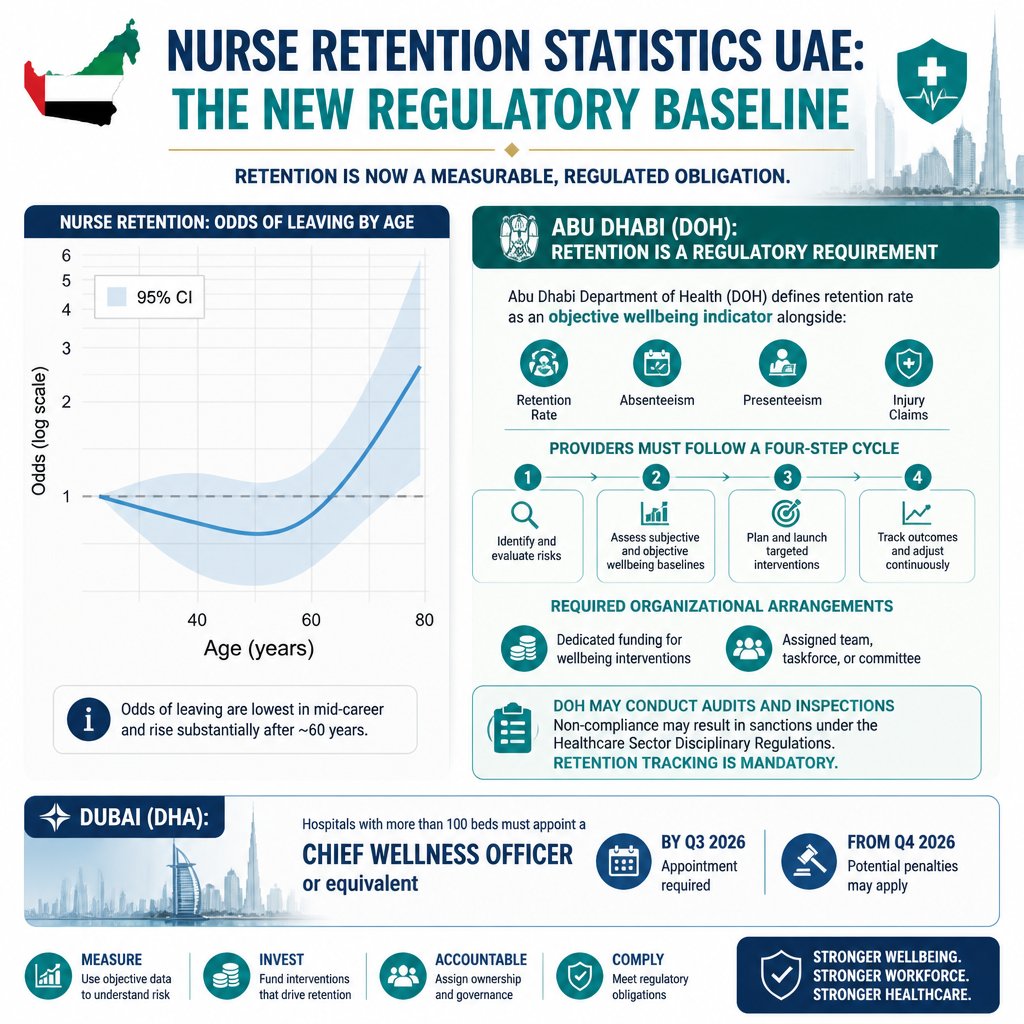
Abu Dhabi’s DOH now formally defines retention rate as an “Objective Wellbeing” indicator — the same policy category as absenteeism, presenteeism, and injury claims — meaning it’s measured with data, not opinion, and hospitals must track it as part of a Comprehensive Workforce Wellbeing Program.
-
The policy requires providers to complete four sequential steps: identify and evaluate wellbeing risks, assess a wellbeing baseline (both subjective and objective), plan and launch targeted interventions, then track and adjust — a structured cycle, not a one-time survey.
-
Every provider must designate a budget or funding source specifically for wellbeing interventions as part of the policy’s required organizational arrangements, and assign a team, taskforce, or committee to own it.
-
DOH has explicit enforcement authority, including audits, inspections, and sanctions under the Healthcare Sector Disciplinary Regulations for policy breaches — retention and wellbeing tracking are not optional reporting exercises in Abu Dhabi anymore.
-
Dubai’s DHA runs a parallel but distinct initiative: hospitals with more than 100 beds must name a Chief Wellness Officer or equivalent by Q3 2026, with potential penalties starting Q4 2026 — giving Dubai’s retention push a named accountable individual rather than only a documented program.
Nurse Retention Statistics UAE: How Big Is the Turnover Intention Gap?
-
A 2025 peer-reviewed study found 40.8% of UAE nurses report high intention to leave, with the strongest predictors being work environment quality and job satisfaction — both statistically significant and independent factors.
-
A separate 2026 study of 313 UAE nurses across various healthcare settings found only 20.1% intended to leave, describing UAE turnover intention as “lower compared to global benchmarks” and crediting favorable workplace practices for the gap.
-
The difference between these two figures illustrates a core retention-statistics principle: methodology and sample matter enormously. Different facility types, employment statuses (public vs. private, local vs. expatriate), and survey timing can swing turnover intention by 20 percentage points or more within the same country.
-
Years of experience, employment status, and nationality were all statistically significant predictors of intent to leave in the larger 2025 study, meaning UAE retention risk isn’t evenly distributed — it concentrates in specific workforce segments rather than applying uniformly to all nurses.
Nurse Retention Statistics UAE: What’s Actually Driving Nurses to Leave
-
Compensation and benefits, and work-life balance are the two most consistently cited turnover drivers across multiple UAE-specific studies of private-sector nurses in Dubai, ahead of any other single factor.
-
A study of nurses at a private UAE facility found 89.9% reported job dissatisfaction, with heavy individual workload (66.7% agreement), lack of supervisory support (59.4%), lack of leadership support (72.5%), and low perks and benefits (78.2%) all cited as contributing factors.
-
95.7% of nurses in that same study reported experiencing burnout, and 79.7% said they worked under constant time pressure — evidence that burnout and workload are not marginal factors but near-universal experiences among the surveyed workforce.
-
Turnover intention differs significantly by clinical unit, not just by employer or pay. An Abu Dhabi tertiary hospital study found emergency and maternity units carried the highest turnover intention, while operating theatres and perioperative care had the lowest — meaning blanket, facility-wide retention programs may miss unit-specific risk concentrations.
-
Occupational stress research across UAE healthcare workers found emotional exhaustion and depersonalization scores were notably high, with income, employment type, and work-to-leisure time conflict as the strongest statistical predictors of burnout severity.
-
Many nurses who do leave migrate abroad specifically citing better benefits and lower cost-of-living pressure, not just higher nominal pay — a distinction that matters because it means UAE retention strategies competing purely on base salary may be solving the wrong variable.
Nurse Retention Statistics UAE: What the National Strategy Prescribes
-
MOHAP’s National Strategy for Nursing/Midwifery: A Roadmap to 2026 explicitly calls for “approved policies to regulate national salary and benefit structures for nurses” — a direct, government-level acknowledgment that compensation standardization is part of the retention solution, not left purely to individual employer discretion.
-
The same national strategy calls for establishing formal “methods and standards for recruitment and retention of nurses/midwives” — meaning retention isn’t being left to ad hoc facility-level programs; it’s a named pillar of federal nursing policy.
-
The strategy also targets structural, longer-term levers: building a career progression mechanism within HR pathways, introducing nursing curricula into schools from grades one through twelve, and launching a national accreditation program for nursing excellence — all aimed at improving the profession’s local image and pipeline, not just current-employee retention.
Nurse Retention Statistics UAE: What Retention Investment Actually Costs
-
Replacing a single specialist clinical hire costs UAE facilities an estimated AED 150,000–200,000 (roughly $41,000–$54,000) in recruitment and onboarding — a figure that makes even substantial per-nurse retention spending look inexpensive by comparison.
-
Established retention benefit categories in UAE healthcare recruitment already include annual return flights, educational allowances for dependents, competitive medical insurance, and housing accommodation or housing loans — benefits specifically designed to offset the cost-of-living and family-separation pressures that peer-reviewed studies identify as turnover drivers distinct from base salary.
Why Nurse Retention Statistics UAE Figures Disagree
If two studies on the same country give you turnover intention numbers 20 points apart, here’s what’s actually happening:
-
Sample and setting matter enormously. A study drawn from private-sector Dubai nurses reporting compensation and work-life balance complaints will show different numbers than a broader national sample spanning public and private facilities.
-
“Turnover intention” is not the same as actual departure. Intention-to-leave surveys measure a psychological state, which can run higher or lower than what facilities’ own HR turnover data eventually show — Dubai’s reported 18% actual hospital turnover sits between the two intention-survey figures.
-
Unit-level and role-level variance is real and significant, not statistical noise — emergency and maternity nursing carries meaningfully different retention risk than perioperative care within the very same hospital.
-
Regulatory tracking is brand new, so historical retention-rate trend data for the UAE, unlike the U.S. or Hong Kong, doesn’t yet exist in a standardized, government-mandated format — the DOH policy only takes effect in September 2026, meaning the next 12–24 months will produce the first real baseline dataset.
What Actually Improves Retention, According to the Evidence
-
Fix workload and staffing ratios first. Nearly every UAE-specific study identifies workload and inadequate staffing as the top or near-top driver of turnover intention and burnout — ahead of, or tied with, compensation.
-
Target benefits beyond base pay, specifically housing support, dependent education allowances, and return flights — these directly address the cost-of-living and family-separation pressures UAE-specific research flags as distinct from salary level. [web:183][web:186]
-
Build unit-specific interventions, not just facility-wide ones. Emergency and maternity units need different retention support than perioperative care, based on documented variance in turnover intention by clinical area.
-
Invest in supervisory and leadership support directly — lack of supervisor and leadership support were cited by roughly 60–73% of dissatisfied nurses in UAE-specific research, a fixable, low-capital-cost lever compared to pay restructuring.
-
Meet the new DOH baseline-and-track cycle honestly. Providers required to assess wellbeing baselines in 2026 should treat this as an opportunity to identify their actual retention risk concentrations, not a compliance box to check quickly.
Employer-led staffing reform, supervisory training, and licensed clinical mental health support remain the primary tools for addressing the burnout and workload drivers behind UAE nurse turnover. Some facilities are also exploring complementary, non-clinical wellbeing resources to supplement licensed care — remote sessions such as Ne Ste Al Frequency Therapy, for example, as one additional layer alongside employer-provided mental health support, not instead of it.
Ne Ste Al does not diagnose, treat, cure, or prevent any medical or psychiatric condition, and individual results vary; nurses experiencing burnout or clinical symptoms should consult a licensed healthcare provider first.
Frequently Asked Questions
What is the actual nurse retention rate in the UAE?
There is no single, standardized national figure yet — retention rate only became a formally mandated tracking metric under Abu Dhabi’s DOH policy effective September 2026. Current indicators include Dubai’s reported 18% annual hospital turnover and peer-reviewed turnover-intention studies ranging from 20.1% to 40.8%, depending on sample and methodology.
Why do turnover intention studies in the UAE show such different numbers?
Sample composition, facility type (public vs. private), and survey timing all significantly affect the result. A 2025 study found 40.8% intention to leave, while a 2026 study of 313 nurses found 20.1%, with the latter explicitly attributing the lower figure to favorable workplace practices in the specific settings sampled.
What are the biggest drivers of nurse turnover in the UAE?
Compensation and benefits, work-life balance, heavy workload, and lack of supervisory or leadership support are the most consistently cited drivers across UAE-specific studies. One private-facility study found 95.7% of nurses reported burnout and 78.2% cited low perks and benefits as contributing factors.
Is the UAE government requiring hospitals to improve nurse retention?
Yes. Abu Dhabi’s DOH mandates a Comprehensive Workforce Wellbeing Program, with retention rate as a named tracked indicator, effective September 2026, backed by audit and sanction authority. Dubai’s DHA separately requires large hospitals to name a Chief Wellness Officer by Q3 2026. MOHAP’s national nursing strategy also calls for standardized salary and benefit structures and formal recruitment-and-retention standards.
Does turnover intention vary by nursing specialty in the UAE?
Yes. A tertiary hospital study in Abu Dhabi found turnover intention was significantly higher in emergency and maternity units than in operating theatres and perioperative care, indicating that retention risk is concentrated in specific clinical areas rather than spread evenly across a facility.
Related
Nurse Turnover in U.S. Hospitals
Nurse Shortage Statistics UAE 2026
Sources
-
Healthcare Workforce Wellbeing Policy (March 2026) — Department of Health – Abu Dhabi (DOH)
-
UAE National Strategy for Nursing/Midwifery: A Roadmap to 2026 — Ministry of Health and Prevention (MOHAP)
-
Factors Influencing Job Satisfaction and Turnover Intention Among Nurses in the UAE — PLOS ONE
-
Impact of Nurse Turnover on Patient Care in a Private Healthcare Facility in UAE — World Journal of Biology Pharmacy and Health Sciences
-
Unit-Based Differences in Compassion Satisfaction, Burnout, Secondary Traumatic Stress, and Turnover Intention Among Nurses in a Tertiary Hospital in Abu Dhabi — Frontiers in Public Health
-
The Paradox of Nurse Turnover: Wealth, Yet Inadequate Retention — University of Gloucestershire
-
Exploring the Reasons for the Turnover of Nurses in Private Hospitals of Dubai — University of Gloucestershire
-
Recruiting and Retaining Healthcare Professionals — Al Tamimi & Company
-
UAE Healthcare Workers Set Guinness Record as 18% Nurse Turnover Strains Gulf Hospitals — Zavis Intelligence Desk